Thursday, 24 February 2011

Still waters run deep

Whoop! Today I was finally accepted onto the City University science journalism MA. After reading countless articles these days about the failing newspapers, graduate competition and lack of positions opening I'm really hoping this will give me the edge in future job markets! I think my place was won solely on my Geoscientist internship and the experience it gave me, let's hope it's worth the £8000 fees. My next article for the magazine is published here first, exclusive to my blog, for the time being at least. Enjoy!


Still waters run deep


In 1911 a meteorite from Mars hurtled towards North Africa, splitting into forty small pieces, and (legend has it) killing a dog. Harriet Jarlett reports.


Geoscientist Online 23 February 2011

Vein of martian clay and carbonate


Exactly a century after the first nakhlite meteorite was discovered in El-Nakhla, Egypt, the same meteorite is being used to discover how water may have flowed on Martian surfaces1. (together with other samples from Lafayette, Yamoto and Governador Valadares meteorites).


The Nakhla meteorite is a rare type of meteorite, being a sample of the planet Mars that was splashed off the surface of the red Planet by another meteorite impact. Mars, having a much lower gravitational pull than the Earth, requires a much smaller impact to force ejecta out of its gravity well, and into interplanetary space. Some of these escaped ejecta then find their way towards the Earth.


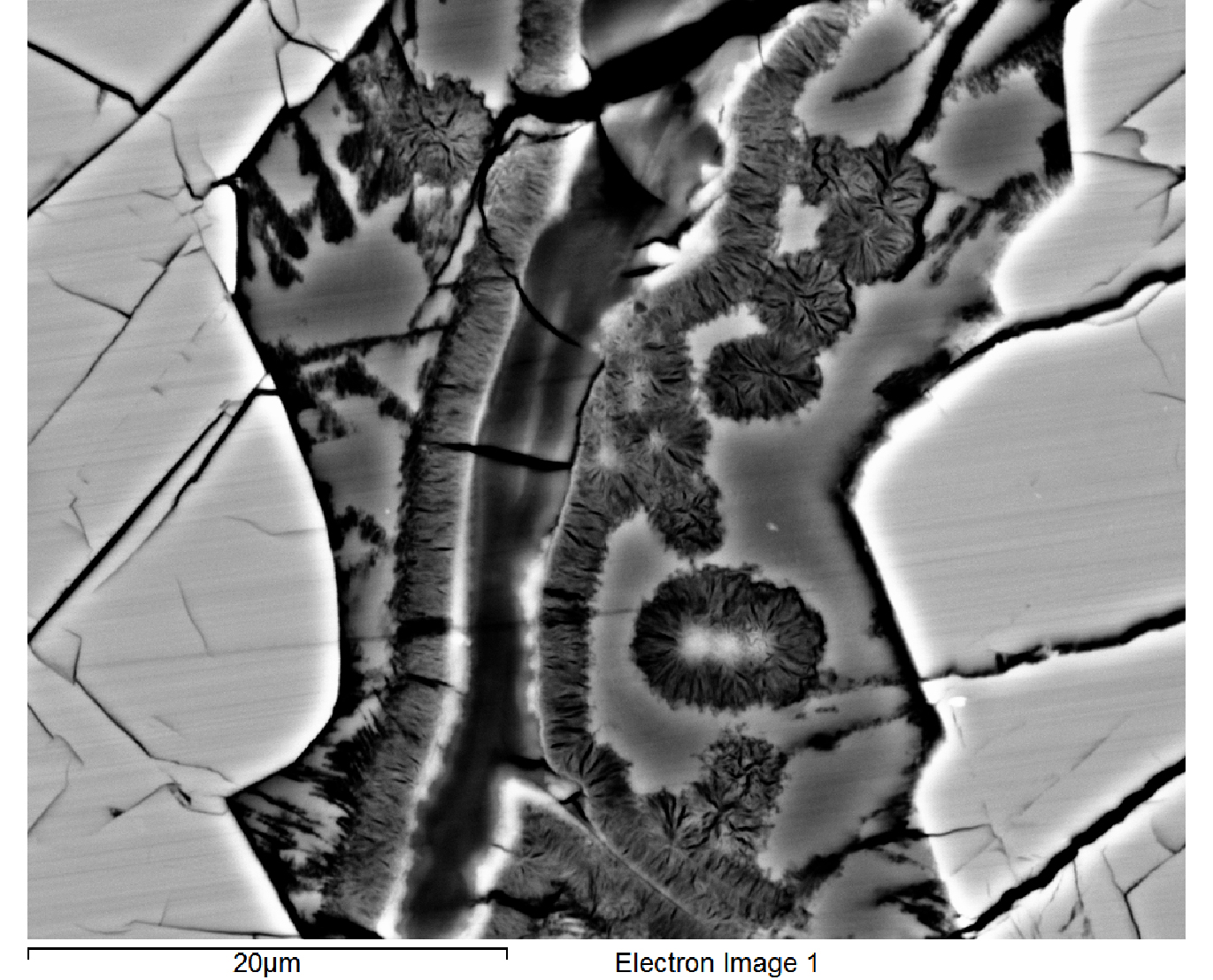
Scientists from the University of Leicester’s Space Research Centre milled micron-thin slices off the martian meteorite fragments and examined them under the electron microscope in an attempt to understand the hydrothermal processes which formed the secondary minerals infilling some prominent veins.


The veins formed when a brine flowed through the rock (a lava) while it was still part of its parent planet. These veins were already known to have contained ice, carbonate and clay minerals in amounts corresponding to their depth below martian surface (the shallower meteorites contain soluble salts)2, which formed during the impact that sent them hurtling towards the Earth.


Changela and Bridges suggest the fluid came from an underground source, such as permafrost; and since deeper nakhlites, like Lafayette, show greater amounts of alteration Changela and Bridges realised that the water had not percolated downwards from the planet surface but instead flowed upward, like water rising from an aquifer to a source spring.


Changela suggests that an impact shock caused the minerals to fracture, and the subsurface permafrost to melt and flow through nearby rock. Dr Bridges, who is supervisor to Hitesh Changela’s PhD, explains the importance of this discovery: “We are now starting to build a realistic model for how water-deposited minerals formed on Mars, showing that impact heating was an important process.”
Martian serpentine atomic layers


Bridges and Changela have been able to identify what size of impact would be needed to form such a hydrothermal system, and can match this to the age and hemisphere in which the nakhlites were born. They have then been able to model how much fluid was likely to have been formed, and how long the system lasted for (one to 10 months).


This discovery comes soon after Mars orbiters revealed carbonate and phyllosilicates on the surface of the planet, such as those found in the Nili Fossae region, where surface fluvial activity and shallow lake deposits may have resulted in carbonate formation3. Clay minerals identified in the walls of impact craters suggest local hydrothermal systems created by impacts are common to the Martian surface.


Further reading:
Alteration assemblages in the nakhlites: Variation with depth on Mars (pp 1847–1867)H G CHANGELA and J C BRIDGES Meteoritics & Planetary Science 45, Nr 12, 1847–1867 (2011) Article first published online: 6 JAN 2011 | DOI: 10 1111/j 1945-5100 2010 01123

Wednesday, 16 February 2011

Love makes the world go round...


...And makes missions successful! February is the month for all things love related and whilst some of our Valentine's were disastrous for NASA's Stardust mission February 14th 2011 turned out to be full of romance.


Space has rarely left the news recently, in particular with the Kepler telescope discovering new, Earth-like planets and the exciting simulated walk on the red planet with the Mars500 project. One of the most exciting discoveries came yesterday when Stardust came within 180km of the comet, Tempel 1. Sending 72 images back to NASA and numerous details about the comet's dust, Stardust will be able to provide great insight into how these huge balls of ice and dust change over time. Comets are thought to contain frozen primordial ingredients that date back to the birth of the solar system some 4.5 billion years ago, information about them could provide us with clues to how the planets and stars form.

Images taken through the day of Tempel 1 by Stardust,
Not only did Nasa have cause for great celebration after the success of their mission, but a scientist working on the project made sure this was a Valentine's day not to forget. Steve Chesley, of NASA's Near-Earth Object Program office was presenting data about the mission and slipped an extra powerpoint slide into the presentation reading 'Will you marry me?'
 

The Stardust mission has provided some fascinating insight into the inner workings of the comet, by imaging the surface. It's bigest achievment is  providing data on what happened when, in 2005, the Deep Impact sent a less-than-romantic impactor hurtling into the comet. The crater this impact left has a small mound in the centre which suggests that some of the ice which was thrown up in the collision came straight back down. Pete Schultz of Brown University explained the "cometary nucleus is fragile and weak based on how subdued the crater is we see today". He went on to explain that because of the frayed edges of the crater it is obvious the surface has changed since the impact, " the crater partly healed itself." Erosion features, newly formed pits and holes were visible on the surface, clearly altered compared to images sent back from Deep Impact. These all form as the comet moves closer to the sun, causing ice to evaporate off of the surface and form the dust 'tail' of the comet.

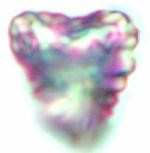
This isn't the first time Stardust has given NASA a present on V-day. In 2006 analysis of data sent back from the comet showed some of the comet particles to be heart shaped!


Heart-shaped comet particle extracted from aerogel - http://stardust.jpl.nasa.gov/news/status/060221.html

Friday, 21 January 2011

You can't get blood from a stone... or can you?

Two years ago I visited Canyonlands in Utah and I  thought even the most hardened rock-hater could be moved to geologise over the spectacle. However, after recently seeing new images of Blood Falls in Antarctica I think I've found a new contender for my top Geological Wonder of the World, the one place where it seems you CAN get blood from stone.

Blood Falls, Antarctica
With such an unexpected and gory appearance, especially against the bleak icy landscape of Antarctica, I can't understand why Taylor Glacier is not mentioned more often. Especially when the striped red sands of Arizona's 'The Wave' (especially with the recent 127 Hours film just released) and the Grand Canyon are so well known, and the processes which formed them are considered general knowledge.   

The Wave in Arizona
Although it seems as if a miracle, and the Earth literally appears to be bleeding, the processes which formed Blood Falls are in fact well known.  It was originally thought that algae lived on the surface of the ice and caused the colouration but last year something more spectacular was discovered.

The glacier is actually underlain by a dank and salty lake with no oxygen, light or food source. The lake formed 2 million years ago when Snowball Earth events caused part of the Antarctic Ocean to become trapped and the brine concentrated to be three times as salty as normal seawater. Despite less-than-savoury conditions, there are still microbes living there (seventeen different types to be exact), which have been there since the lake formed and have learnt to 'eat' sulphates and to 'poop' out iron. It's as this waste iron rises 400m to the surface and reacts with oxygen to form the red rust colour that it stains the ice to look like blood.

Diagram by Zina Deretsky, ref: Science doi:10.1126/science.1167350
These microbes exist in such unfavourable conditions that they are one of the best and most easily accessible (scientists don't even need to drill through the ice to reach them) extremophiles for NASA and other astrobiology organisations to use in research to discovere how  places like Mars and Europa could support life. 

Tuesday, 11 January 2011

What's black and white and red all over?

A sunburnt Panda! Although neither of the two Giant Pandas moving to Edinburgh Zoo will have to worry about sunburn.

My little sisters favorite things in the whole world are Pandas. When she was little and asked where she wanted to go on family days out her answer was inevitably 'the zoo', and she would wile away hours in front of their cage talking to Ming-Ming (who was later sent away in disgrace after fighting with her mate).  Although, my sister isn’t the only person afflicted by Panda fever, everybody loves Pandas and the Sneezing Panda was one of the most watched videos on YouTube. So what is it that makes these animals so cute?


In 1973 Nobel Prize winner Konrad Lorenz, a zoologist, put quantitative measurements on ‘cuteness’. He listed several infantile traits such as small body size, a disproportionately large head, large eyes, playfulness and curiosity. It’s easy to see that a wide eyed panda, rolling around whilst chewing his bamboo shoot with his funny human-like thumb (which is in fact an adapted wrist bone) would fit all of these traits.


These childlike features trigger a nurturing response in people so they respond more positively to animals that look like babies. It’s not restricted to people either, think about all those stories of gorillas adopting kitten and hippos adopting tortoises. Small cute things appear vulnerable and helpless so we want to adopt them. It’s an evolutionary trick, which has been in use for millenia. The recent find of a baby Triceratops skull with an overly large skull shows even ancient species knew the benefits of being a cutie-pie.


Although, I think the biggest reasons we like pandas is just that they are out right funny, with their black eyes they look like they smudged their make up from the night before and haven’t slept in a week, whilst their endangered nature make them the underdog we all love to help out.

With their guaranteed cute appeal it looks like Tian Tian and Yangguang will be welcomed with open arms to Edinburgh Zoo.


Facts about Pandas:
The giant panda is listed as endangered in the World Conservation Union's (IUCN's) Red List of Threatened Animals. It is one of the most critically endangered species in the world. There are about 1,000 left in the wild.

The Wolong Giant Panda Reserve is the world’s largest panda reserve and research institution. It is also the world’s largest breeding base and panda sperm bank.

Sunday, 9 January 2011

It's Cheese, Gromit, But Not As We Know It!

As a child asked what I wanted to do when I grew up, I would ignore the likelihood that my asthma, 5'1 height and lack of army training would probably prevent my dream and reply 'Astronaut'. Well twelve lucky, strong-lunged and tall men got to live out my dream and visit the Moon. Now, over forty years on, the Apollo missions are once again proving their scientific worth and are back in the forefront of scientific minds as new analytical techniques applied to  seismic data taken from the moon during Apollo has discovered the Moon has a liquid core like our Earth. 

In the final Apollo mission (the only geologist astronaut), Harrison Schmitt, collected a pristine and beautiful moon rock sample, Troctolite 7653. Full of milky white and dark green crystals, an analysis of this sample showed evidence of magnetic alignment, and the possibility of a liquid Moon core. It can now be compared with data collected between 1962 and 1977 when the Apollo missions deployed four seismic stations which recorded seismic tremors beneath the Moon's surface.

Dr Schmitt poses with the American flag, with the Earth in the background.
 The new research shows that the core seems to have both a solid and a liquid section, similar to our own Earth, however it also contains a partially melted section which our own planet is missing containing both large lumps of rock as well as magma. Dr Renee Weber (a very accomplished woman in science and the project scientist for the Lunar Mapping and Modeling Project) and her colleagues analyzed this data to find the moon has a core of 330Km diameter, which is still liquid even 4.5 Billion years after the moon formed! She is currently involved in, what is now a very important, proposal to send seismic data instruments back to the Moon. Although, sending modern technology to the Moon surface has no guarantee of producing better results. The rarity of Moonquakes means data is sparse, whilst the cracked and broken surface means signals are masked by noise, hence why computers of the seventies were unable to decode the signals they received then. 

The Moon's layers
 Up until now the topography and mineralogical composition of the moons surface was well understood, but it's interior remained in doubt. If the Moon did indeed form when a Mars sized object impacted the partially molten Early Earth then it stands to reason it would contain various heavy elements and light elements which would separate out into a core, mantle and crust. Weber understands the implications of her discovery. "If we have any hope of determining once and for all how the moon formed then we need to understand it's structure completely." 

It seems Gromit will need to find some more evidence before we all agree with his theory that the Moon is in fact made from cheese.


Wednesday, 8 December 2010

Climate research excrementally better!

One thing in science journalism has always struck me as odd, how very few science stories contain something which make them interesting reading from the title on. 'Humans made from arsenic' is hardly going to catch your eye and imagination on the tube into work is it? So when I found this press release from the University of Leicester about how a weird rodents urine can be used to detect climate change I was shocked. I mean, it has everything; cuddly furry animals? Check. Toilet humor? Check. Politically sensitive topic? Check. And (my favourite) it proves just how un-geeky scientists can be, what with the leader of the research group having to use his intensive rock climbing skills to scale mountains in South Africa to cut samples out with giant angle grinders. Brilliant!


The Rock Hyrax is the closest relative of the elephant (despite looking like a giant guinea pig) and whilst sharing similar tusks is always a giveaway of a genetic relationship, the fact that they both have similar toilet habits is what really gets scientists going. Rock Hyrax's share communal toilet spaces (called middens) over generations spanning thousands of years, and as these build up and crystallise they form perfect, stratified samples of climate history. 


In South Africa it can be hard in the dusty and dry deserts to get any organic material with which to sample past climate change. The Rock Hyrax's fossilised urinals contain metabolites and plant matter which can be dated and analysed to test how their habitat changed over the generations which used the midden. These can then be compared with deep ocean core data which has been taken nearby to get an incredibly accurate picture of how climate has varied in southern Africa over the past 30 000 years. And this new data will help produce ever more accurate climate modelling systems, and with this new found use for urine historical climate records can only get excrementally better!


Tuesday, 7 December 2010

Ain't no mountain high enough


Two of my favourite things in the world are geology and Christmas, and rarely do they interact so neatly as with the Christmas lectures at  the Royal Institute. Although, since they require all adults to bring a child, (and I do not own one of these, nor know of one I could legally borrow) I cannot gleefully whoop as they  suscept clearly unstable models to the effects of gravity, or Ahhh over the timelapse images of erosion on Earth's largest mountains. 

This year Dr Mark Miodownik discusses how size is limited on Earth. It's always intrigued me how our planet keeps itself so carefully within it's most suitable limits, in particular how our planet works hard to make sure nothing grows too large, yet humans strive for the biggest things we can get, biggest house, biggest christmas tree and tallest buildings. 

Despite being the product of the biggest building events in history, mountains are in fact dominated by erosional processes; mass wasting, glaciers and rivers all try their damndest to bring mountains back down to sea level. Although most of these processes are affected by climate, does this mean that with global warming the erosional processes will dry up and our mountains will keep growing until they reach the moon? 

Well which planet, despite a cooler climate and far less water, is the overly-confident guy insisting size matters? Winning the blue ribbon for the largest mountain in the solar system, Olympus Mons, it's Mars! The unseen force of gravity is the biggest factor in building things high above the planet's surface and Mars has the smallest values in the solar system, which is what gives it such impressive building power. 


And gravity will have it's say even in human construction. As clever building methods and lighter materials mean new buildings go up every  year claiming to be 'the tallest building in the world"  soon a natural homeostatic level will be reached where our greed for ever taller buildings will be quashed. Gravity will decide we've had enough and will prevent our buildings climbing into the stratosphere. As these buildings only get a fraction taller every year, it suggests we're reaching that limit soon. 

Although there's still plenty of time for us to genetically modify a Christmas Tree to 1200ft high!